

Resource
CLAT Syllabus 2027/2028: Latest & Detailed
CLAT Syllabus 2027/2028: Latest & Detailed Section-Wise Breakdown
7 min read

CLAT 2027 · NLU Guide Best NLUs in India 2026:
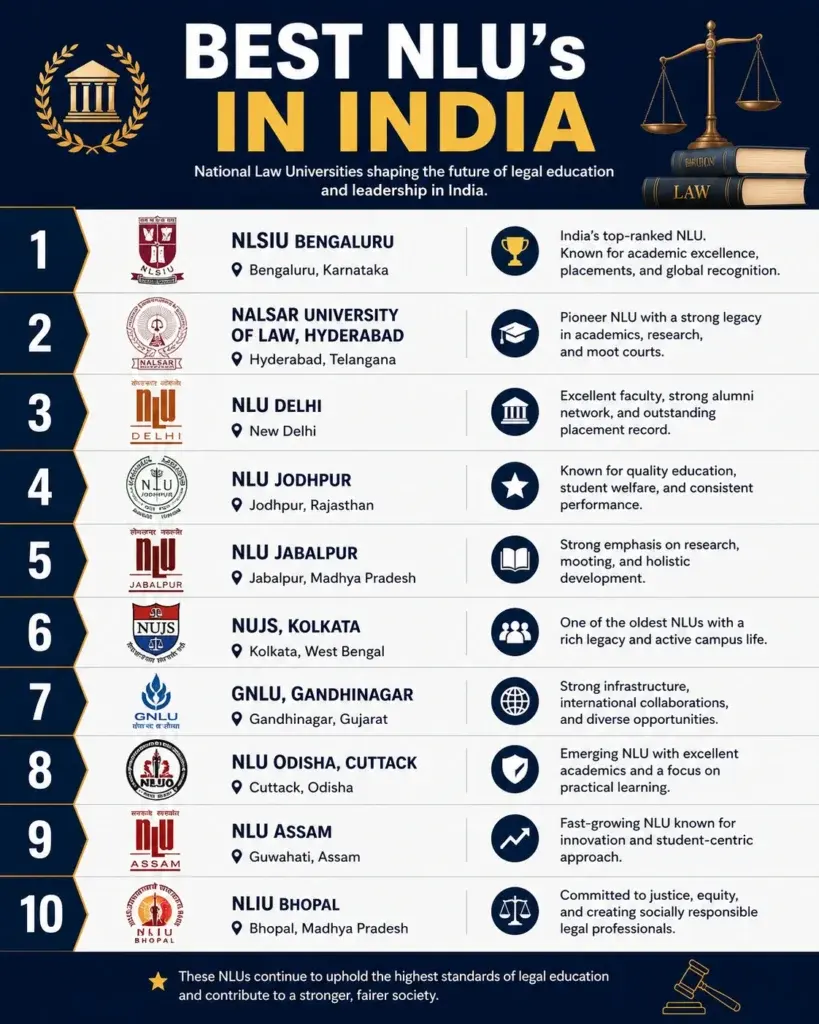
Twenty-five National Law Universities, one CLAT rank card, and dozens of trade-offs between prestige, fees, location, and placements. Here is a clear-eyed, rank-wise breakdown to help you build a smart preference list.
📅 Updated July 2026⏱ 11 min read🎯 UG & PG CLAT Aspirants
25NLUs under CLAT
26Total NLUs in India
4,500+UG seats nationwide
#1NLSIU Bengaluru (NIRF)
Every CLAT aspirant eventually asks the same question: which NLU should I actually aim for? The honest answer depends on your rank, your budget, and what you want out of law school — litigation exposure, a corporate law placement, or simply the most affordable respectable degree. This guide walks through the NIRF-anchored pecking order, real fee structures, closing CLAT ranks from the last counselling cycle, and placement data so you can set realistic targets instead of chasing name recognition alone.
The Ministry of Education’s NIRF (National Institutional Ranking Framework) is the closest thing India has to an official law school ranking. It scores institutions on teaching & learning resources, research & professional practice, graduation outcomes, outreach & inclusivity, and perception. Note the NIRF 2026 list was not finalised as of this writing — most portals are still working off NIRF 2025 data, and NLSIU Bengaluru has held the No. 1 spot for roughly a decade running.
Rankings matter, but for a five-year commitment, weigh them alongside placement consistency, fee-to-outcome ratio, and — if you qualify for a home-state quota — the specific advantage that gives you at your own state’s NLU.
Tier 1 — consistently top 5, hardest to crack
NIRF #1Est. 1987
NIRF #2AILET, not CLAT
NIRF #4-5Corporate + Intl law
NIRF #6-7Highest median salary
Tier 2 — excellent outcomes, wider rank window
NIRF #8Fastest riser
EstablishedDesert campus
North India hubValue pick
ConsistentCentral India
Why Strategic Study is Important for CLAT Aspirants | CLAT 2027
HPNLU Shimla and MNLU Mumbai have shown noticeable jumps in median salary and placement percentage in the latest NIRF data submissions — worth considering if your rank sits just outside the traditional top tier.
These are indicative General-category closing ranks from the most recent counselling cycle. Ranks shift every year with the difficulty of the paper and number of applicants — always cross-check live data during CLAT 2026 counselling.
| NLU | NIRF Rank | ~5-Yr Fee | Gen. Closing Rank | Median Salary |
|---|---|---|---|---|
| NLSIU Bengaluru | 1 | ₹25 L | ~120 | High (2nd highest) |
| NLU Delhi* | 2-3 | ₹21 L | AILET-based | ₹18 LPA |
| NALSAR Hyderabad | 4-5 | ₹15.35 L | ~250 | ₹18 LPA |
| WBNUJS Kolkata | 6-7 | ₹17 L | ~400 | ₹20 LPA |
| GNLU Gandhinagar | 8 | ₹14 L | ~550 | Strong, rising |
| NLU Jodhpur | Tier 2 | Moderate | ~650 | Solid |
| RGNUL Patiala | Tier 2 | Moderate | ~1100 | Variable (large batch) |
*NLU Delhi is outside the CLAT Consortium and admits only through AILET.NALSAR University of Law
NALSAR University of LawNALSAR University of Law

Seat allotment during CLAT counselling runs on your preference order. A short list built only on “dream colleges” can leave you with no seat at all if cutoffs move against you.
Split your list into dream picks (above your realistic rank), realistic picks (matching your rank), and safe picks (comfortably within your rank). Order them dream → realistic → safe.
A BBA LLB from a Tier 1 NLU generally carries more weight than a BA LLB from a newer one — the institution’s reputation and placement record matter more than the exact stream.
If your state has its own NLU, the reserved-seat cutoff there is often significantly more forgiving than the open-category cutoff elsewhere — a genuine strategic lever.
Significant rank movement happens in rounds 3–5 and spot rounds. Don’t lock in early out of anxiety — track your options until the counselling window closes.
1. Which NLU is the only one that does NOT admit through CLAT?
Correct Answer: B
NLU Delhi is not a member of the CLAT Consortium and conducts its own entrance exam, AILET (All India Law Entrance Test), for UG, PG, and PhD admissions.
2. As per recent NIRF-linked data, which NLU recorded the highest median placement salary?
Correct Answer: C
WBNUJS Kolkata recorded a median salary of around ₹20 LPA, edging out even NLSIU and NLU Delhi in this metric — a reminder that rank and salary don’t always move together.
3. NIRF law rankings weigh which of the following parameters?
Correct Answer: C
NIRF uses a composite of five broad parameters, not a single metric — which is why a college can rank high overall while lagging on one specific factor like median salary.
Question
“Rankings alone are an inadequate basis for choosing a professional institution.” Critically examine this statement in the context of legal education in India. (150 words)
Rankings like NIRF offer a useful, standardised comparison of teaching quality, research output, and institutional perception, and they remain the most transparent public benchmark available to law aspirants in India. However, they compress diverse strengths — faculty mentorship, regional placement networks, cost of education, and cultural fit — into a single composite score, which can obscure real trade-offs. A newer NLU may offer lower fees and strong niche placements while ranking below an older, costlier institution on aggregate metrics. Similarly, median salary figures can diverge sharply from overall rank, as seen when a lower-ranked NLU outperforms a top-ranked one on graduate outcomes. A sound institutional choice therefore requires triangulating rankings with fee structures, placement consistency, location, and quota eligibility, rather than treating a single ranking figure as a complete verdict on quality.1. Quality of Legal Education
NLUs follow a rigorous, case-method and seminar-style pedagogy, unlike many traditional law colleges that rely on rote learning. Faculty often include practicing lawyers, judges, and researchers, giving students exposure to real-world legal thinking.
Top NLUs (NLSIU Bangalore, NALSAR Hyderabad, NLU Delhi, WBNUJS Kolkata, NLU Jodhpur, etc.) have strong placement pipelines into:
The BA LLB (Hons.) format lets students complete both a bachelor’s degree and law degree in five years, saving time compared to a 3-year LLB after a separate bachelor’s.
NLU alumni networks are deeply embedded in India’s legal, judicial, and policy ecosystem — useful for mentorship, internships, and career referrals.
NLUs have strong moot court cultures (Philip C. Jessup, Willem C. Vis, etc.) and structured internship programs with law firms, NGOs, courts, and government bodies — building practical skills alongside academics.
Many NLUs offer electives/specializations in areas like IP law, constitutional law, international law, corporate law, and human rights law, letting students tailor their legal education.
An NLU degree carries strong recognition with employers, judiciary, and higher education institutions abroad (useful for LLM applications to Oxford, Cambridge, Harvard, etc.)
NLU graduates are well-represented in judicial services, UPSC (especially with a legal edge in GS-II and Essay), legislative drafting, and policy think tanks.
For students with a CLAT rank inside the top 120–150, most counsellors consider it worth it given the consistent NIRF #1 position and strongest overall alumni network, though NALSAR and WBNUJS offer comparable or better cost-to-outcome ratios.
A few routes exist outside the main CLAT cycle: NLSIU offers a 3-year LLB via NLSAT, and some NLUs like NLU Odisha and NLU Visakhapatnam run separate admission processes for their 3-year LLB programmes.
Not necessarily. Placement data shows meaningful variation — some mid-tier NLUs post strong median salaries, while a few top-tier ones with larger seat intakes report lower overall placement percentages. Institutional reputation still matters, but check placement consistency rather than rank alone.
Historically there have been multiple rounds plus spot rounds, with real movement continuing through rounds 3–5. Staying active in the process matters more than locking in early.
Rank realistically, budget honestly, and don’t let a single ranking number make the decision for you.
#CLAT2027#NLU#NIRFRanking#LawAspirants#LegalEducationIndia


CLAT Syllabus 2027/2028: Latest & Detailed Section-Wise Breakdown

CLAT 2028 Batch for Droppers: Why CLAT IQ Is the Right Choice

AILET Complete Preparation Strategy: A Holistic Guide to Cracking NLU Delhi's Entrance Exam