
Resource
CLAT Syllabus 2027/2028: Latest & Detailed
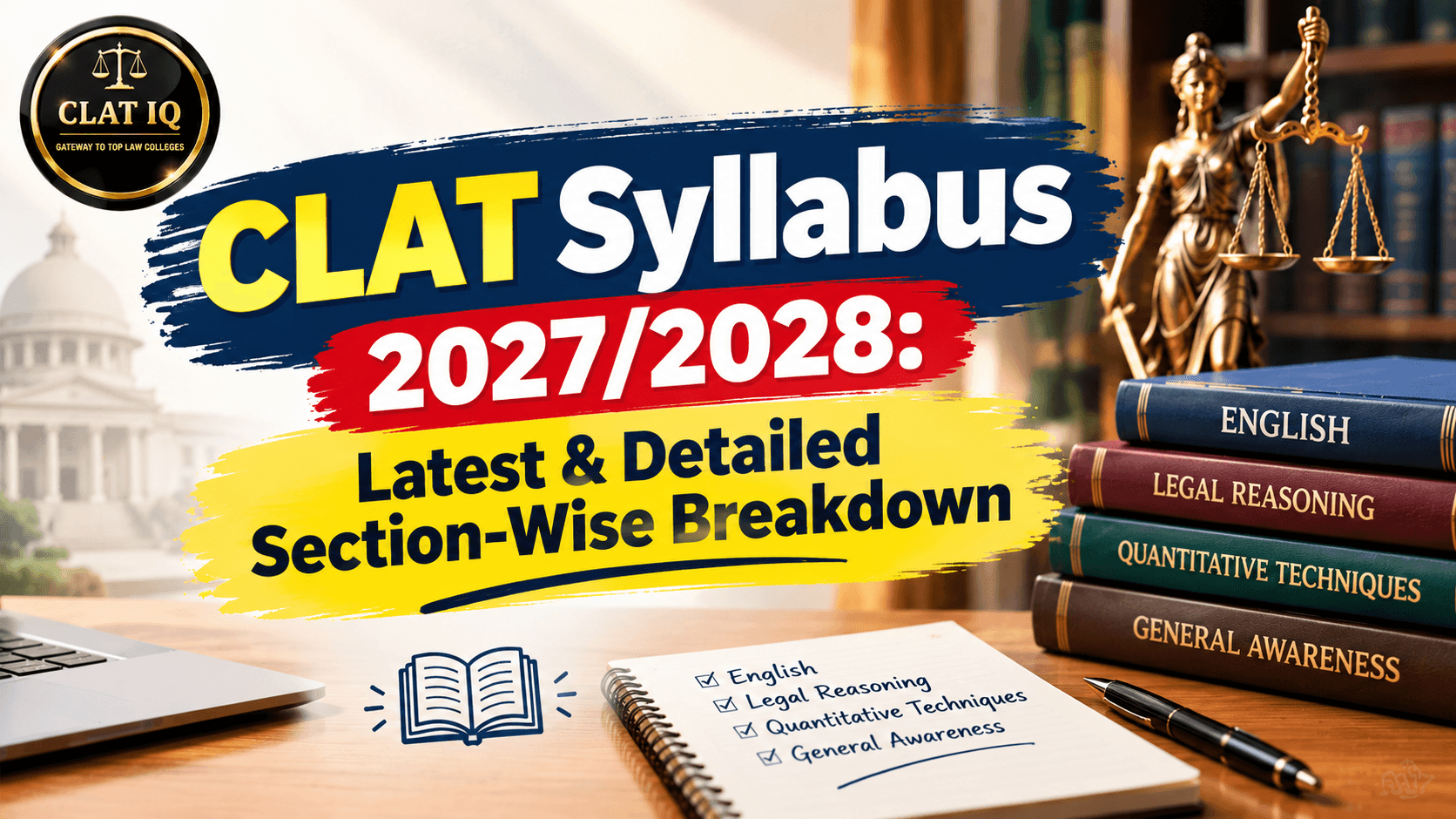
CLAT Syllabus 2027/2028: Latest & Detailed Section-Wise Breakdown
7 min read
If you’re preparing for CLAT, two things decide how your entire year will go: knowing exactly when things happen, and having a solid plan for the one section that scares almost everyone — Quantitative Techniques, better known as CLAT Maths. This guide covers both in detail: a full timeline of CLAT 2027 dates so you never miss a deadline, and a section-by-section strategy to turn Maths from your weakest link into a reliable scoring section.CLAT 2027: Important Dates and a Complete Maths (Quantitative Techniques) Strategy
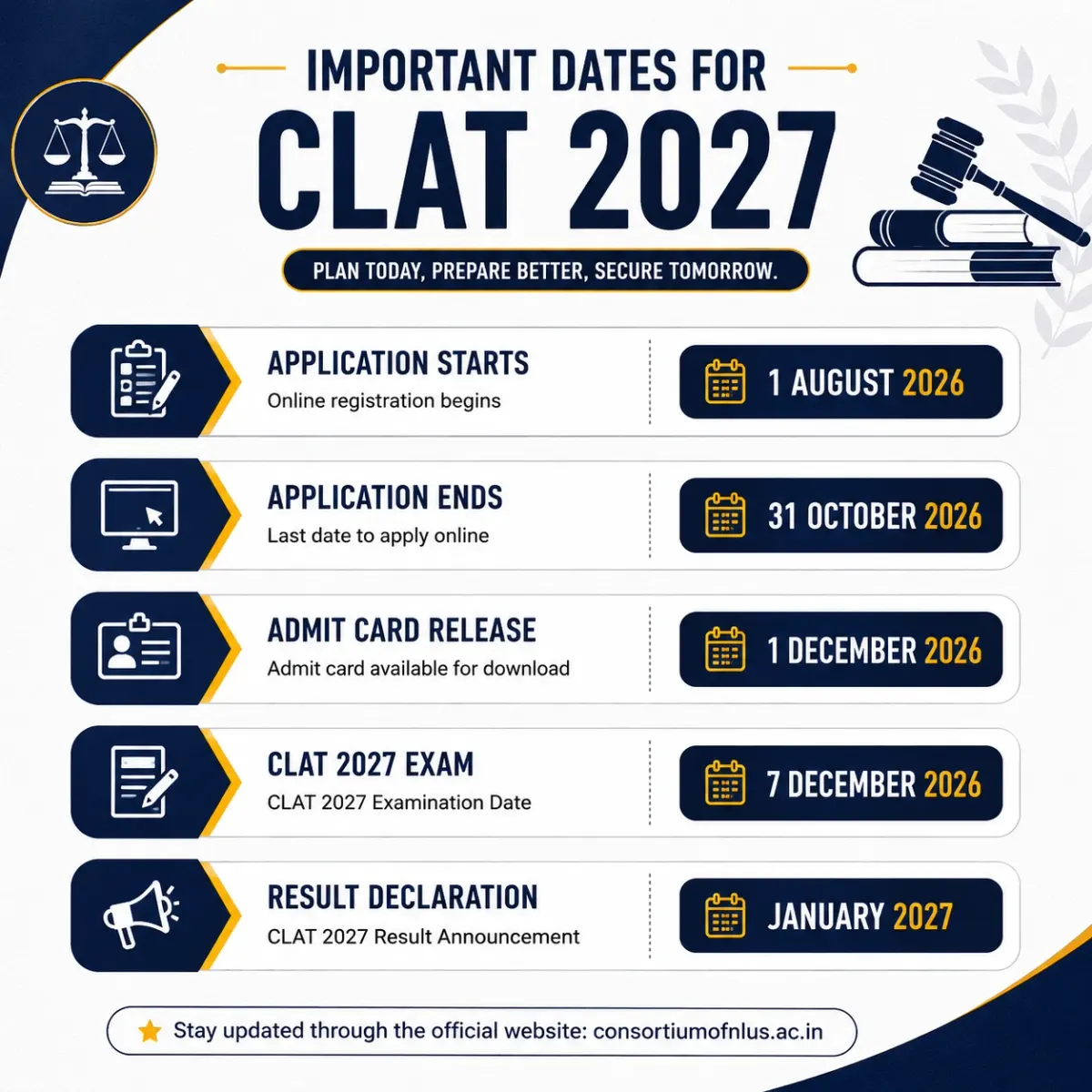
CLAT is conducted by the Consortium of National Law Universities (NLUs), and unlike UGC-NET or JEE, it isn’t run by a central government testing agency. This means the Consortium sets its own calendar every year, and while the pattern is fairly consistent, exact dates are only confirmed once the official notification drops. As of now, the Consortium has indicated that CLAT 2027 will be held once in the year 2026, with the exam expected in December 2026, following the pattern of the last several years where CLAT has consistently been held on the first Sunday of December.CLAT 2027 — Important Dates You Need to Track
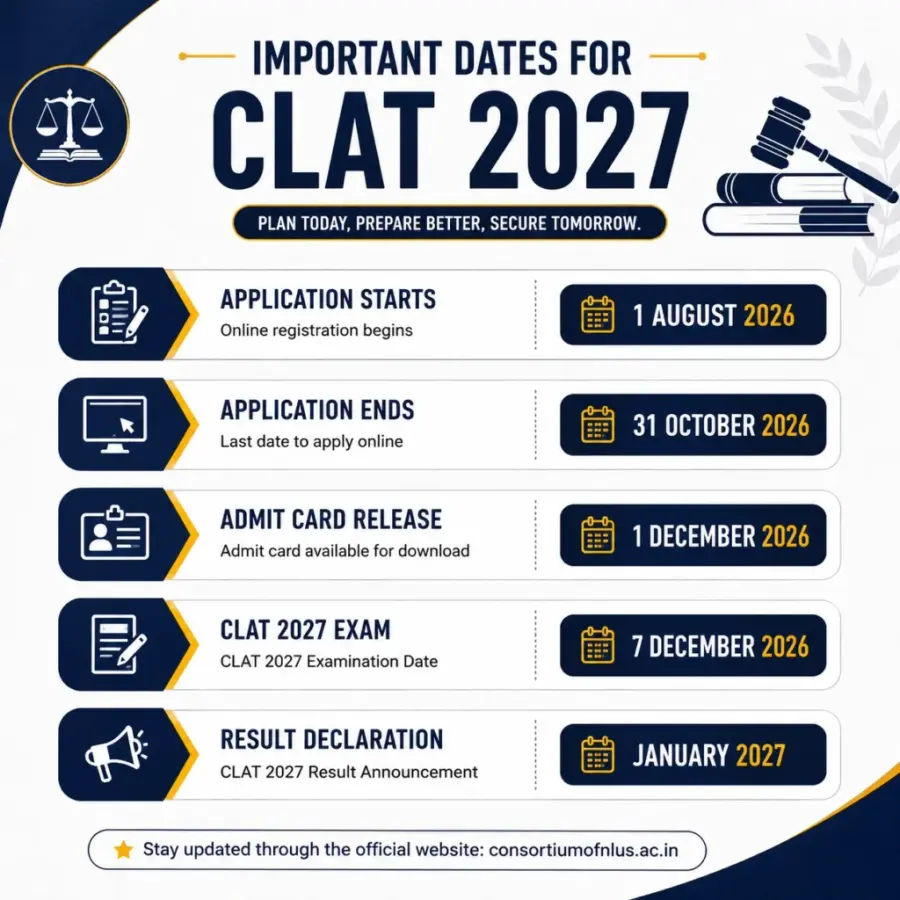
Here’s the expected timeline, based on how the last few CLAT cycles have played out. Treat these as planning anchors, not gospel — always cross-check the official notification once released.
1. Official Notification — Expected July 2026 This is the starting gun. The notification is released on the official Consortium website (consortiumofnlus.ac.in) and contains everything: the confirmed exam date, registration schedule, eligibility criteria, exam pattern, fee structure, and syllabus. Don’t rely on coaching institute summaries or social media posts for this — download the actual PDF and read it end to end. Small print changes (a tweak in negative marking, a shift in section weightage) can matter a lot for your strategy.
2. Registration Window Opens — Expected 1 August 2026 Online applications typically open in the first week of August. You’ll need a valid mobile number and email ID, followed by OTP verification, before you can fill in personal, academic, and communication details.
3. Last Date to Apply — Expected 31 October 2026 Based on past trends, the registration window usually stays open for close to three months. Do not wait until the last week — Consortium servers tend to slow down or crash under heavy last-minute traffic, and a missed deadline here costs you an entire year.
4. Admit Card Release — Expected November 2026 Admit cards are usually released 2–3 weeks before the exam. Download and print it as soon as it’s live; don’t leave this for exam week.
5. CLAT 2027 Exam Date — Expected 6 December 2026 (Sunday) This is the single most important date on your calendar. CLAT has been conducted in December for several years running now, and this cycle is expected to follow the same pattern. The exam is a 2-hour, pen-and-paper test with 120 questions across five sections: English Language, Current Affairs including General Knowledge, Legal Reasoning, Logical Reasoning, and Quantitative Techniques.
6. Result Declaration — Expected mid-to-late December 2026 Results are usually declared within 10–15 days of the exam.
7. Counselling Process — Expected last week of December 2026 onward This includes registration, choice filling, seat allotment rounds, and fee payment, all within strict deadlines. A good rank can genuinely go to waste if counselling choices are made carelessly or deadlines are missed, so treat this phase with as much seriousness as the exam itself.
Working backward from an early-December exam date, here’s a simple way to structure your year:
A useful habit: bookmark the official Consortium website and check it weekly once July arrives, rather than depending on third-party aggregators, which sometimes carry outdated or slightly inaccurate information.CLAT 2026: Applications Open, Entrance Exam Date, Last …
Now let’s talk about the section most CLAT aspirants dread — and the one that, ironically, offers some of the easiest marks in the entire paper if you approach it correctly.100+ Essential Legal Terms for CLAT 2026 | Complete Glossary
Quantitative Techniques in CLAT isn’t really a “maths test” in the way your school exams were. It’s a data-interpretation and comprehension test disguised as maths. You’re given a short passage — often containing a table, chart, graph, or a set of numerical facts — followed by 3 to 5 questions based on it. The underlying calculations are almost always Class 8–10 level: percentages, ratios, averages, simple and compound interest, profit and loss, time-speed-distance, and basic data interpretation.
The difficulty doesn’t come from the maths itself. It comes from three things:
The good news: because CLAT restricts itself to fairly basic concepts, this is one of the most “trainable” sections in the entire exam. Unlike Legal Reasoning, where interpretation can be subjective, or Current Affairs, which is genuinely unpredictable, Maths rewards structured practice almost linearly. Put in the hours, and your score will go up — reliably.

Quantitative Techniques typically carries around 10–14 questions out of the 120-question paper, translating to roughly 10–13 marks with +1 for each correct answer and negative marking for wrong attempts (usually -0.25). While that’s the smallest section by question count, a few things make it disproportionately valuable:CLAT 2027: Important Dates and a Complete Maths (Quantitative Techniques) Strategy
Here’s a breakdown of the topics that consistently appear in CLAT Quantitative Techniques, roughly ordered by how frequently they show up:
1. Percentages The backbone of this entire section. Nearly every other topic — profit/loss, interest, data interpretation — is built on a solid understanding of percentages. Practice converting fractions to percentages instantly (know your 1/8, 1/7, 1/6 conversions by heart) because this alone will save you enormous time.
2. Ratio and Proportion Frequently tested both directly and as a tool within data interpretation questions. Get comfortable with compounded ratios and the idea of dividing a quantity in a given ratio.
3. Averages Simple in concept but often combined with other topics (average speed, weighted averages in DI sets). Understand the difference between a straightforward average and a weighted average — CLAT loves testing that distinction.
4. Profit, Loss, and Discount Standard business-maths problems. Learn the shortcut relationships between cost price, selling price, marked price, and discount percentage so you don’t have to build equations from scratch each time.
5. Simple and Compound Interest Usually 1–2 direct questions. Memorize the standard formulas cold, and practice the compound interest shortcut for 2-year problems (CI = P[(1+r/100)^n – 1]) since it appears often enough to be worth automating.
6. Time, Speed, and Distance / Time and Work Occasionally tested, sometimes embedded in a word-problem passage. Focus on relative speed concepts (trains crossing each other, boats and streams) since these are common CLAT favorites.
7. Data Interpretation (Tables, Bar Graphs, Pie Charts, Line Graphs) This is where most of the section’s questions actually live. A passage presents data — say, sales figures across five years, or population data across states — and asks you to calculate percentage change, ratios, differences, or averages from it. The maths involved is basic; the skill being tested is how efficiently you extract and use numbers from the visual or tabular data.
8. Basic Algebra and Number Series Rarely the focus, but occasionally used as a wrapper within a passage-based problem. Don’t over-invest here — a light revision is enough.
Phase 1: Concept Building (6–8 weeks) Go topic by topic through the list above, starting with percentages and ratios since everything else depends on them. Use a Class 8–10 level maths textbook or a dedicated CLAT Quant book — you genuinely don’t need anything more advanced. For each topic:
Phase 2: Passage-Based Practice (4–6 weeks) This is the phase most students skip, and it’s the one that actually determines your CLAT Maths score. Standalone questions and passage-based questions test the same maths but require very different skills. Practice reading a data set quickly, identifying exactly what’s being asked, and pulling only the numbers you need — ignoring the rest of the passage. Time yourself: aim to read and understand a typical DI passage in under 45 seconds.
Phase 3: Speed and Accuracy Drilling (ongoing, 4–6 weeks and beyond) Once concepts are solid, shift focus entirely to speed. Useful habits:
Phase 4: Mock Tests and Error Analysis (final 8–10 weeks before the exam) Take full-length CLAT mocks under timed conditions, but after each one, spend more time reviewing than you spent taking the test. For the Maths section specifically:
With 120 questions in 120 minutes, you genuinely cannot afford to get stuck. For the Quantitative Techniques section specifically:

A simple, sustainable weekly rhythm during your core preparation months might look like this:
As you move closer to the exam, shift this balance increasingly toward full-length mixed mocks that combine all five sections, so you get used to managing Maths within the context of the full 120-question, 2-hour format — not in isolation.
CLAT rewards two very different skills at once: disciplined planning around a fixed, unforgiving calendar, and steady, structured effort on a section like Maths that many aspirants wrongly write off as “not worth it.” Track the Consortium’s official notification closely once it’s expected around July 2026, register well before the likely October deadline, and use the months leading up to the December exam to convert Quantitative Techniques from a source of anxiety into one of your most dependable scoring sections.
The exam favors preparation over panic. Build your calendar early, respect every deadline, and treat Maths as the learnable, high-accuracy section it actually is — not the intimidating one it’s reputed to be.
Note: CLAT 2027 dates mentioned in this article are based on historical patterns and are expected/tentative until officially confirmed. Always verify final dates on the official Consortium of NLUs website (consortiumofnlus.ac.in) once the notification is released.

CLAT Syllabus 2027/2028: Latest & Detailed Section-Wise Breakdown
CLAT 2028 Batch for Droppers: Why CLAT IQ Is the Right Choice

AILET Complete Preparation Strategy: A Holistic Guide to Cracking NLU Delhi's Entrance Exam