
Resource
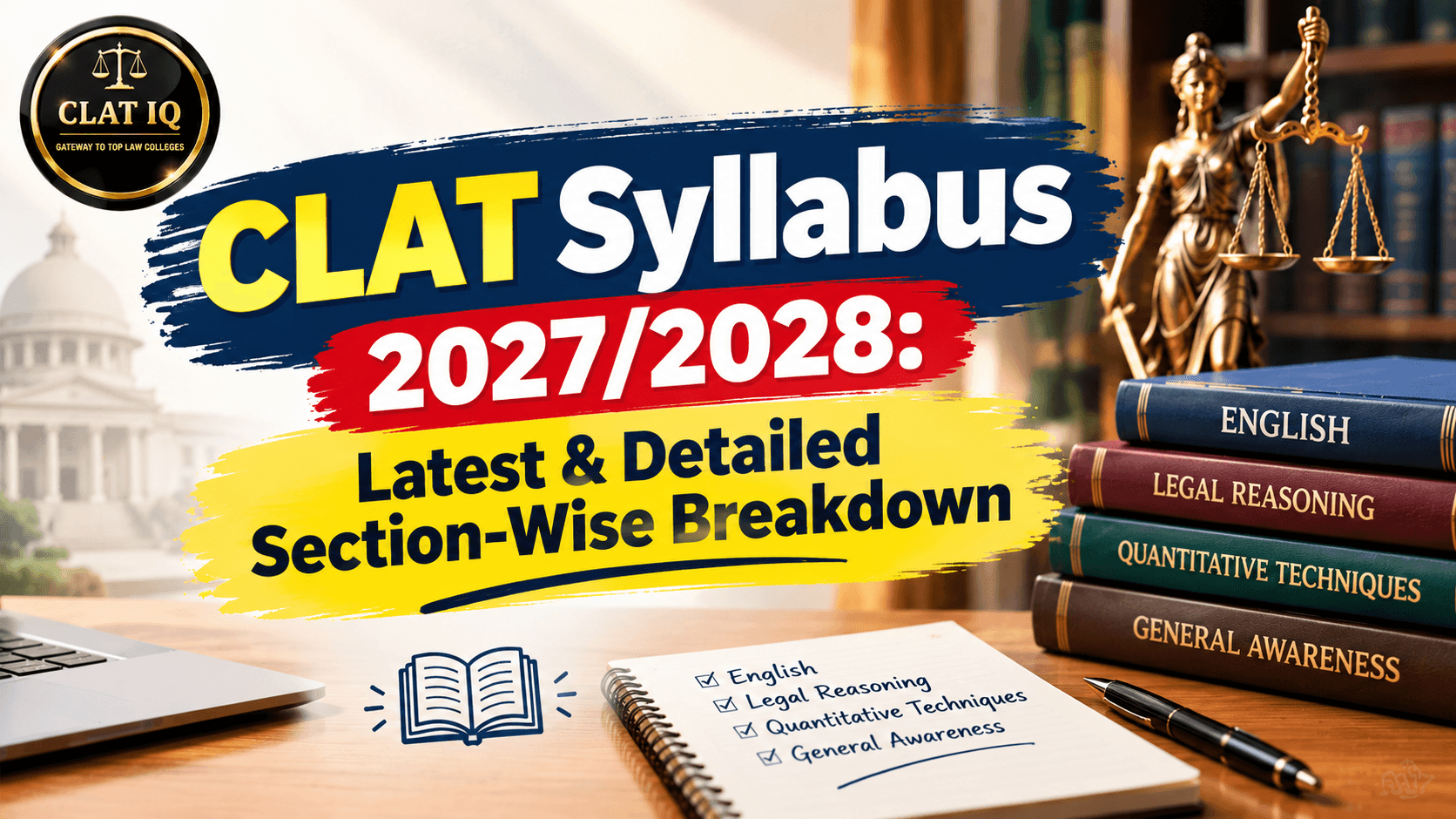
CLAT Syllabus 2027/2028: Latest & Detailed
CLAT Syllabus 2027/2028: Latest & Detailed Section-Wise Breakdown
7 min read

Every year, lakhs of students walk out of their Class 10 board exam hall with one big question hanging over them: “What next?” For a growing number of students in India, the answer is law — and specifically, cracking the Common Law Admission Test (CLAT) to get into one of the country’s National Law Universities (NLUs).CLAT After 10th
If you’re a Class 10 student (or a parent researching on behalf of one) wondering whether it makes sense to start preparing for CLAT right now, this guide is for you. We’ll cover everything — from what CLAT actually is, to whether you’re even eligible after 10th, to a detailed two-year action plan, subject-wise strategy, common myths, and mistakes to avoid.

The Common Law Admission Test, or CLAT, is a national-level entrance examination conducted for admission to undergraduate (BA LLB, BBA LLB, etc.) and postgraduate (LLM) law programs offered by 24+ National Law Universities across India, including NLSIU Bangalore, NALSAR Hyderabad, NLU Delhi, NLU Jodhpur, and many others. A number of private universities and law schools also accept CLAT scores, which widens the pool of institutes you can target with a single exam.
CLAT is not just another entrance test. It is widely considered the gateway to some of the most prestigious legal education in the country. A good CLAT rank can open doors to:CLAT 2026 UG Syllabus
Because the stakes are high and competition is fierce (CLAT typically sees well over 60,000-70,000 applicants for a few thousand seats across NLUs), students and parents are increasingly looking to start preparation as early as possible — which is where “CLAT after 10th” comes in.
This is the most important clarification to make upfront: you cannot sit for CLAT immediately after Class 10.
The eligibility criteria for CLAT’s undergraduate program require that a candidate has passed (or is appearing for) the Class 12 board examination with a minimum aggregate score (typically 45% for general category and 40% for SC/ST, though exact percentages can vary slightly year to year — always check the official CLAT notification for the current cycle). There is no separate CLAT exam or pathway that lets a Class 10 student enrol directly into a five-year law program.
So when people say “CLAT after 10th,” what they actually mean is:
Starting your CLAT preparation journey after Class 10, so that by the time you finish Class 12, you are fully prepared to take the CLAT exam and secure a seat at a top NLU.
This is an extremely smart approach — think of it as building a two-year runway before takeoff, rather than trying to prepare for CLAT in just a few months during or after Class 12, when board exam pressure is at its peak.

Most students only start serious CLAT preparation in Class 12, often just 8-10 months before the exam. This creates unnecessary pressure and forces students to juggle board exam preparation with CLAT prep simultaneously. Starting right after Class 10 solves several problems at once:
CLAT tests four to five sections: English Language, Current Affairs (including General Knowledge), Legal Reasoning, Logical Reasoning, and Quantitative Techniques. These are skill-based sections, not rote-memorization subjects — and skills like reading comprehension, logical thinking, and awareness of current affairs take time to build. Two years gives you the room to build these skills slowly and steadily rather than cramming.CLAT Without Maths: Complete Strategy Guide 2025-26 | ExamPrep
CLAT’s English and Legal Reasoning sections reward students who read widely and comprehend quickly. A habit of reading newspapers, editorials, and non-fiction built over two years is far more valuable than last-minute reading comprehension practice.
The Current Affairs section in CLAT often covers events from the past 12 months, but having a strong base of static GK and a habit of following news for two years makes it much easier to retain and connect new information.
Class 12 is demanding on its own. Students who’ve already built strong reasoning and reading foundations by the end of Class 11 can dedicate Class 12 to fine-tuning, mock tests, and revision — rather than starting from scratch.
Starting early also gives you time to think through whether Humanities, Commerce, or Science is the best fit for you (more on this below), rather than choosing a stream in a rush right after Class 10 results.
A common question students ask is: “Which stream should I take in Class 11 if I want to do CLAT — Science, Commerce, or Humanities?”
Here’s the good news: CLAT does not require any specific stream in Class 11-12. Students from Science, Commerce, and Humanities/Arts backgrounds all appear for and clear CLAT successfully every year. In fact, NLUs value diversity in their student body, and having a Science or Commerce background can sometimes even work in your favour for certain elective subjects later (like Intellectual Property Law, Taxation Law, or Cyber Law).
That said, here are a few practical considerations:
Bottom line: Choose the stream you genuinely enjoy and can perform well in for your board exams, since board exam performance still matters for CLAT eligibility (minimum aggregate) and for keeping options open. Don’t switch to a stream you dislike purely because you think it “helps” with CLAT — consistent reading habits and reasoning practice matter far more than your stream choice.
Let’s break down each CLAT section and how a Class 10-passed student can start building skills early.
Beyond subject-specific prep, what separates strong CLAT performers from average ones is a broader “mindset” built over time. Three habits matter most:
1. Daily reading, non-negotiably. Whether it’s a newspaper, a good non-fiction book, or quality long-form journalism, aim for at least 30-45 minutes of focused reading every single day. This isn’t just about content — it trains your brain to process complex sentences quickly, which is exactly what CLAT’s compressed time-per-question format demands.
2. Curiosity about “why,” not just “what.” When you read about a new law, policy, or Supreme Court judgment, don’t just note what happened — ask why it happened, what principle is at play, and what could be the counter-argument. This habit directly strengthens Legal Reasoning and Current Affairs performance.
3. Comfort with ambiguity and time pressure. CLAT rewards quick, confident decision-making under time constraints. Playing timed puzzle games, solving reasoning questions with a stopwatch, or even competitive quizzing can help build this comfort well before Class 12 exam pressure sets in.
Here’s a simplified two-year plan for a student starting right after Class 10:
This roadmap is flexible — adjust based on your own pace, board exam schedule, and how comfortable you feel with each section.
This is a personal and financial decision, and there’s no universally “right” answer. Here are some honest considerations:
Arguments for coaching:
Arguments for self-study:
A balanced approach many families choose WISELY
1. Location and Focus
CLAT IQ is a trusted CLAT coaching institute based in Gomti Nagar, Lucknow, dedicated to helping students crack CLAT, AILET, and other law entrance exams. If you’re in Lucknow or nearby, that means access to a locally-rooted institute rather than a distant, faceless brand. Clatiq
2. Personal Attention, Not Crowd Coaching
The institute is known for expert mentorship, small batch sizes, and personalised guidance — which matters a lot for an exam like CLAT where individual weak areas (reading speed, legal reasoning, GK gaps) need targeted attention rather than one-size-fits-all lectures. Clatiq
3. Learn From People Who’ve Actually Cracked It
Mentorship comes from top CLAT mentors who are themselves graduates of National Law Universities — so the strategy you’re taught isn’t theoretical, it’s tested by people who’ve been through the exam and know what actually works. Clatiq
4. Flexibility — Online or Offline
Students can join CLAT IQ’s online live classes from anywhere in India, with live sessions, recorded lectures, digital study material, and online mock tests. So even if you can’t make it to Gomti Nagar in person, you’re not locked out. Clatiq
5. Mock Tests Built for Real Exam Pressure
The program is built around full-length CLAT mock tests designed to boost speed, accuracy, and time management — critical since CLAT is a 2-hour, 120-question exam where pacing often decides the final score, not just knowledge. Clatiq
6. Built to Fit Around School
The institute is structured so students can prepare for CLAT alongside their Class 12 board exams, with proper time management, mentorship, and a structured study plan — so you’re not forced to choose between boards and CLAT prep. Clatiq
7. Support for Deserving Students
CLAT IQ offers scholarships for students with academic excellence and strong aptitude, which can ease the financial pressure of long-term coaching. Clatiq
8. Options at Every Stage
Whether you’re just starting out or need last-minute revision, mock practice, and strategy improvement closer to exam day, there’s a track designed for where you currently stand.
Mock tests are, without exaggeration, one of the single most important tools for CLAT preparation — but only if used correctly. Here’s how to make them count:
Starting early is a huge advantage — but only if you avoid these common pitfalls:
It helps to keep the bigger picture in mind while you prepare. A good CLAT score can get you into NLUs offering the five-year integrated BA LLB (Hons.) or similar programs. Life after that typically branches into:
Understanding these pathways early can help you stay motivated through the sometimes tedious grind of daily reading and reasoning practice — you’re not just preparing for an exam, you’re building the foundation for a genuinely wide-ranging career.

Starting your CLAT journey right after Class 10 isn’t about rushing into law-specific study — it’s about giving yourself the gift of time. Two years is enough to build genuine reading habits, sharpen logical reasoning, develop a real interest in current affairs, and walk into Class 12 (and eventually the CLAT exam hall) feeling prepared rather than panicked.
Remember: you cannot sit for CLAT directly after Class 10, and that’s perfectly fine — that’s not the goal. The goal is to use these two years wisely, stream choice and board performance included, so that by the time you’re eligible to sit for CLAT after Class 12, you’re not just eligible on paper, but genuinely ready.
Take it one habit at a time — a newspaper today, a reasoning puzzle tomorrow, a mock test next month. Two years from now, you’ll be glad you started early.
Good luck with your CLAT journey!
CLAT Syllabus 2027/2028: Latest & Detailed Section-Wise Breakdown
CLAT 2028 Batch for Droppers: Why CLAT IQ Is the Right Choice

AILET Complete Preparation Strategy: A Holistic Guide to Cracking NLU Delhi's Entrance Exam