
Resource
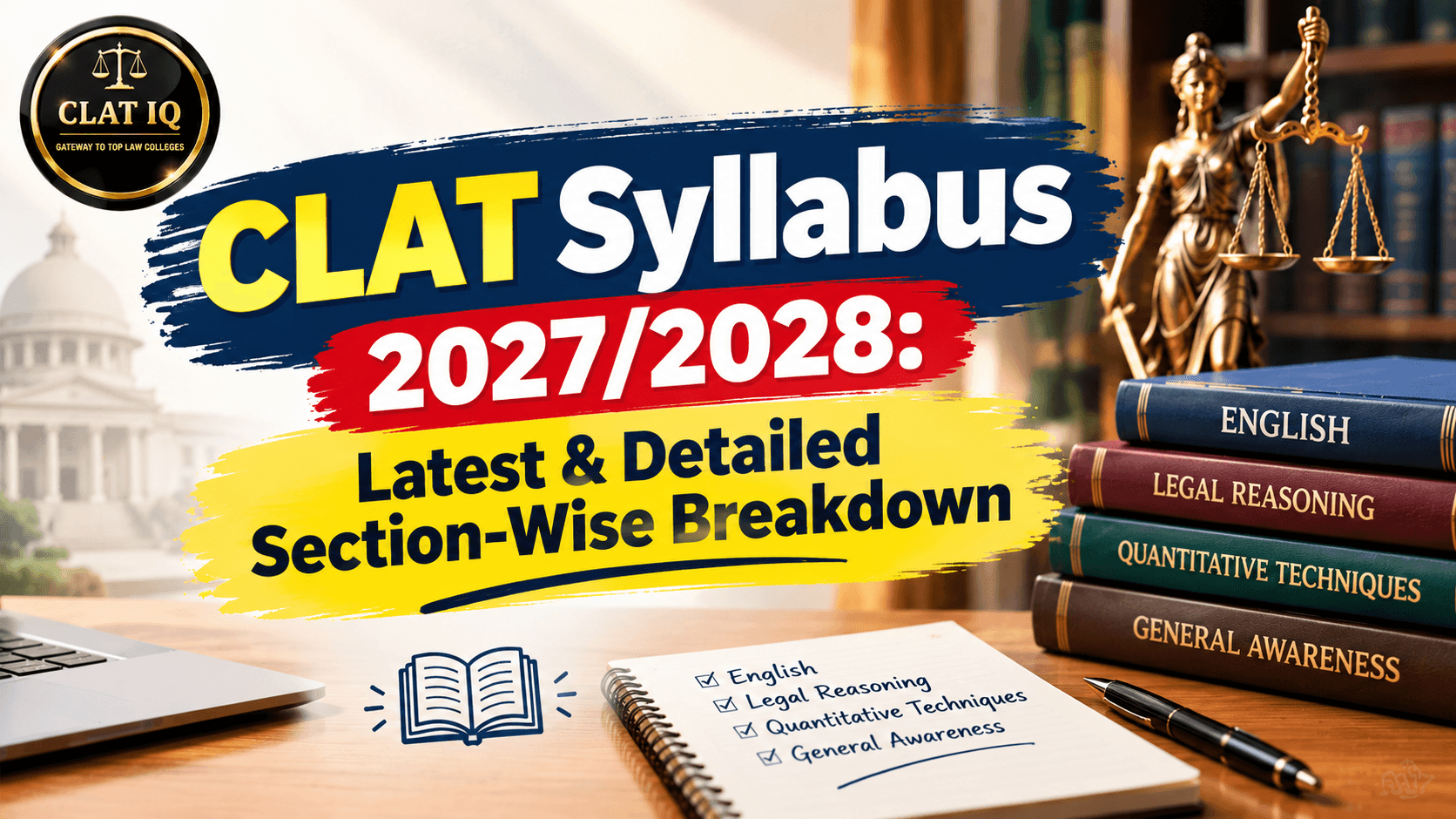
CLAT Syllabus 2027/2028: Latest & Detailed
CLAT Syllabus 2027/2028: Latest & Detailed Section-Wise Breakdown
7 min read

Hey champs! I know you want to give wings to your dreams, which is why you are thinking about CLAT preparation right from Class 11th. This is the perfect time to start preparing for CLAT. Let’s look at the complete strategy on how to prepare for CLAT 2027 after class 11 along with your school syllabus.
English Language — Read one editorial daily and summarise it in two lines. Build vocabulary organically through reading, not word lists. Practice inference questions from RC passages; the answer is always in the text.
Legal Reasoning — Never memorise bare acts. CLAT gives you the principle — your job is to apply it correctly to a new fact situation. Practice with past papers and understand why wrong options are wrong.
Current Affairs & GK — This is your biggest differentiator. Go beyond headlines — understand context, causes, and consequences. Monthly magazines like Legal Edge or CLATalogue GK digest help. Revise monthly.
Logical Reasoning — Passages here test critical thinking: assumptions, inferences, arguments. Solve puzzles and argument-based questions daily. Speed matters here — don’t get stuck.
Quantitative Techniques — Class 10 Maths is sufficient. Focus on data interpretation, ratios, percentages, and averages. It’s only ~10% of the paper — aim for 80% accuracy, not perfection.
How to prepare for CLAT 2027 after class 11 (Common Law Admission Test) is the national entrance exam for top law schools (NLUs) in India. Starting in Class 11 gives you a solid 2-year head start.
first we have to understand the exam pattern
CLAT tests 5 sections (all passage-based):
http://How to prepare for the CLAT exam from class 11? I opt …
Build your foundation:
Introduce Legal Reasoning:
Structured preparation:

Best CLAT Coaching in Lucknow for CLAT 2027 & 2028
| Section | Resources |
|---|---|
| English | RC passages, Norman Lewis, newspaper editorials |
| GK/Current Affairs | The Hindu, Lucent’s GK, monthly CLAT magazines |
| Legal Reasoning | Previous papers, CLAT coaching material |
| Logical Reasoning | RS Aggarwal, CLAT mock tests |
| Quantitative | RS Aggarwal (Class 10 level), CLAT mock tests |
Starting at Class 11 is ideal — you have enough time to build strong reading habits and legal awareness without panic. Would you like a day-wise study plan or coaching recommendations?
CLAT does not test stream-specific knowledge. It tests aptitude, reading speed, and critical thinking.
Stream-Specific Study Plans
Arts / Humanities Stream
This is the most compatible stream for CLAT. Your class syllabus directly help your law exam preparation.
The Advantage: Your school subjects like Political Science, History, cover 60% of the CLAT General Knowledge (GK) and Legal Reasoning themes.
Use your school history and civics chapters to build a strong base for static GK.
Commerce Stream
Commerce students possess strong analytical skills, which are highly useful for the logic and data sections.
The Advantage: Economics helps you understand business, trade, and financial current affairs easily. Accountancy and Mathematics build strong data interpretation skills for the Quantitative section.
Action Plan: Use your comfort with numbers to ace the Math and logical puzzles sections early on.
Watch Out For: You will need extra reading practice. Commerce textbooks can be formula-oriented. Read long-form essays and literature to improve your reading speed for the lengthy legal passages.
🔬 Science Stream (PCM / PCB)
Science students have a heavy school workload but possess excellent problem-solving and logical stamina.
The Advantage: You already possess the analytical mindset required for Logical Reasoning and Quantitative Techniques. You will likely find these sections easier than other students.
Action Plan: Focus your CLAT study hours almost entirely on reading comprehension, legal concepts, and daily current affairs.
CLAT IQ will provide you with a detailed strategy to help you prepare for CLAT alongside Class 11th. Complete preparation is provided through weekend classes and test series. This will be a 2-year program designed to make you fully ready by December for the CLAT entrance exam, which is mostly held in December, so you can secure a selection in a top NLU on your very first attempt.
Dreaming of a Top NLU Right After School? Start Early!
Balancing Class 11th and CLAT prep might seem tough, but with the right strategy, it’s completely doable
A high-impact, four-phase strategy will help you successfully balance your Class 12 board preparation while building an elite rank for CLAT 2027.
Consistency over intensity. Thirty focused minutes daily beats five exhausting hours on weekends.”

Maintain a Reading Discipline: Spend 40–50 minutes every single morning reading the editorial and opinion pieces of The Hindu or The Indian Express. Learn to identify the author’s central argument, changing tones, and logical premises.
Revise Basic Mathematics: Revisit Class 10 NCERT math topics, focusing heavily on percentages, ratios, averages, and profit/loss. CLAT’s Quantitative Techniques section is strictly Data Interpretation heavy, requiring rapid mental calculation.
Try to learn some basics of legal
Try to understand and learn the core concepts of CLAT along with your school work, and practice topics like maths, reasoning, DI (Data Interpretation), and legal.”
English Language & Critical Reading (20% Weightage)
The Goal: Build stamina to read 450-word passages efficiently.
Action: Dedicate 45 minutes daily to reading editorials in The Hindu or The Indian Express.
Focus: Do not just read to finish; actively analyze the author’s tone, identify the central argument, and map the passage’s premises.
Current Affairs & General Knowledge (25% Weightage)
The Goal: Deep analytical understanding of global and national developments.
Action: Rote-memorizing fact sheets from the internet will not help. You must know the “Why” and “How” behind major events over the past 12 months.
Focus: Complement daily newspaper tracking important News which is helpfull for CLAT
| Day | Core concept | Routine to do |
| Daily Habit | Reading & Retention | 45 Mins Newspaper Editorial + 15 Mins Vocabulary learning |
| Mon / Wed / Fri | Concept Building | Legal Reasoning Passages + Critical Logic drills |
| Tue / Thu | Testing | Take a Sectional Mock Test and build up to full-length mocks |
| Saturday | Calculation & GK | 2 DI Caselets + Making detailed Current Affairs notes |
| Sunday | Attempt Mock | Complete 2-hour thorough analysis of everything wrong in your test |
Preparing for CLAT requires a unique blend of critical thinking, intense reading discipline, and unwavering determination
Coaching is helpful, not mandatory. Many toppers have cleared CLAT self-studying with disciplined mock practice. If you do join coaching, make sure the institute has a strong mock test series and mentorship — the quality of tests matters more than lectures.
Online options like CLATapult, Legal Edge, and Endeavor have strong self-paced programmes that work well alongside Class 11–12 school schedules.
CLAT preparation is a marathon, not a sprint. There will be months where your mock scores plateau. That’s normal. The students who crack top ranks aren’t necessarily the smartest — they’re the most consistent, and the most honest about their weaknesses.
Treat every mock as information, not judgment. Track your progress over months, not days. And remember: two years of steady, intelligent preparation is genuinely enough to earn a seat at your dream NLU.
Every page you skip… is a chance someone else seizes.
So start with right time and right guidence
Reagarding CLAT IQ Lucknow

CLAT Syllabus 2027/2028: Latest & Detailed Section-Wise Breakdown
CLAT 2028 Batch for Droppers: Why CLAT IQ Is the Right Choice

AILET Complete Preparation Strategy: A Holistic Guide to Cracking NLU Delhi's Entrance Exam